Stardew Valley: a first spring that leaves room to enjoy the farm
Plan your first Stardew Valley spring with crop deadlines, energy budgets, fishing, mine checkpoints, tool upgrades, and a practical year-one routine.
Take these into your next session
- Plant only what you can water while keeping time for income and exploration.
- Count crop growth from the planting day before spending late-season gold.
- Use rain, mine elevators, and planned tool downtime to make each day easier.
What this guide covers A standard, unmodded year-one farm with normal seasonal crops and default economy settings. Farm layouts, multiplayer time, remixed bundles, and later unlocks change some choices. No perfection deadline, speedrun schedule, or major story spoilers.
A successful first spring is not the farm with the largest field on day two. It is a farm you can maintain while still earning money, gathering materials, meeting villagers, and discovering which activities you enjoy. Too many crops can turn every morning into a watering shift that leaves no energy for anything else.
This plan treats spring as four flexible weeks. It explains useful priorities and the arithmetic behind seasonal planting, without requiring perfect fishing, lucky drops, or a full reset when a day goes badly. You can miss a festival purchase, delay a building, or take a quiet day and still build a healthy save.
1. Give the first day a modest, complete goal
Clear a small space near the farmhouse and a water source. Plant the starter parsnips if they are part of your chosen start, water them, and keep paths clear enough to move easily. Do not spend the whole day removing every tree and stone. Much of that work can wait until tools and energy improve.
Make a chest early so gathering does not constantly fill your backpack. Keep basic wood, stone, fiber, and useful mixed materials rather than selling everything for a small cash boost. A chest near the house helps separate seeds, food, crafting materials, and items you want to investigate later.
Learn the route to town, the shop, and the beach. Check shop hours and closures before planning a same-day purchase. Pierre’s usual Wednesday closure matters when a crop harvest creates money you expected to reinvest immediately. A calendar and the television provide more useful planning information than repeatedly walking to a closed door.
End the day with some margin. Time and energy are separate constraints, and staying out until the forced late-night cutoff can create penalties. Aim to return home comfortably rather than treating the last possible minute as the normal target. A repeatable routine is worth more than one additional item collected in a panic.
2. Budget the morning before buying more seeds
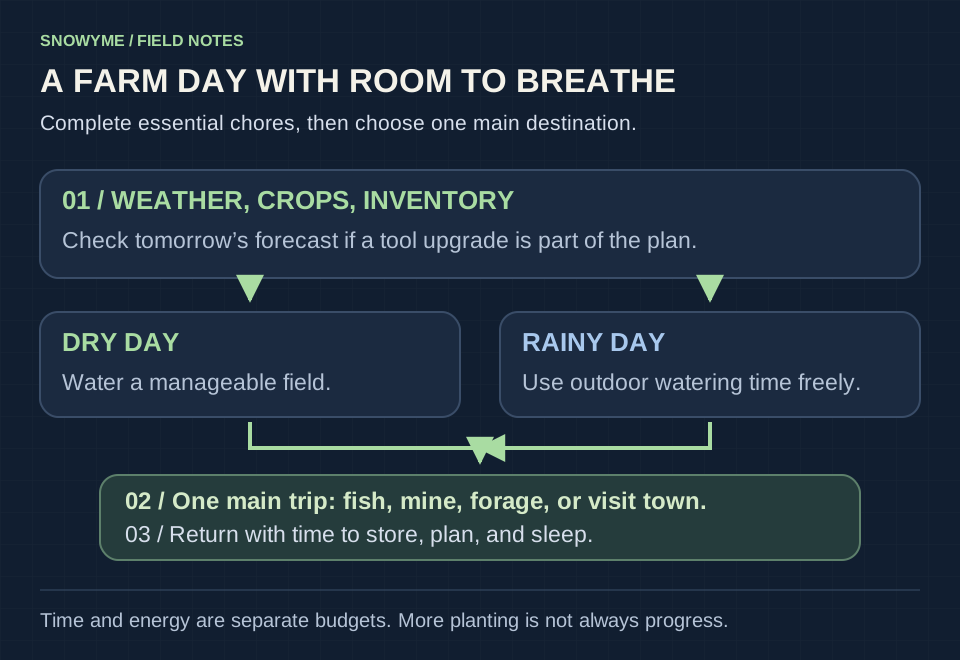
Every additional tile can cost watering time and energy until you gain automation or a rainy day. Plant a field that leaves enough energy for another meaningful activity. If watering consumes nearly the whole bar, expansion has outpaced the rest of your farm.
Use a simple morning check: weather, crops, inventory, then one main destination. On a dry day, water first unless you have a specific reason to delay. On a rainy day, normal outdoor crops are watered for you, which creates room for mining, fishing, or a tool hand-in. Check the weather forecast for tomorrow when planning downtime.
Keep accessible food for longer trips. Forage, fish, or other available food can extend a useful day, but inspect energy and health values before consuming valuable items. It can be better to eat a modest item and finish a mine checkpoint than return home with an almost-complete objective.
If you become exhausted, stop treating more tool use as free progress. Recovery and the next morning matter. You are managing a week, not squeezing the maximum number of swings out of one bar. A small sustainable field often produces more useful total progress because it leaves time to build the rest of the economy.
3. Understand planting dates before chasing profit
For a normal single-harvest crop, the first harvest date is the planting date plus the listed growth time, assuming it is watered every day and no growth modifier applies. The planting day itself is not one completed day of growth. A crop that needs four days and is planted and watered on spring 1 is normally ready on spring 5.
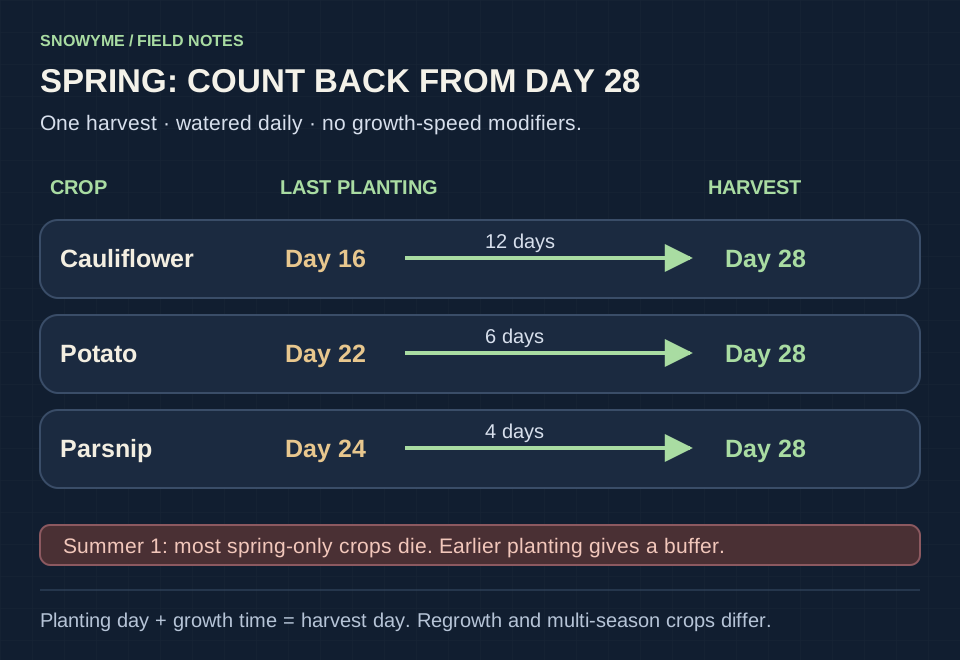
Most spring-only crops die when summer begins. For a harvest by spring 28, subtract the growth duration from 28 to find the latest ordinary planting day. Missing a required watering day delays growth, and fertilizer or professions can change the timing. Treat the following dates as a no-modifier baseline.
| Crop | Normal growth time | Latest spring planting for one harvest | Useful role |
|---|---|---|---|
| Parsnip | 4 days | Spring 24 | Cheap early cycle and a manageable way to learn watering. |
| Potato | 6 days | Spring 22 | A practical early crop; yields can vary, so do not budget only the best outcome. |
| Kale | 6 days | Spring 22 | Another spring option; compare seed cost and goals before buying. |
| Cauliflower | 12 days | Spring 16 | A longer investment that ties up money and watering capacity. |
| Green bean | 10 days to first harvest | Spring 18 for the first harvest only | Regrows, but uses a trellis and needs earlier planting to realize repeated harvest value. |
For a regrowing crop, a late first harvest may technically work while missing most of the reason to buy it. Green beans then regrow every three days under normal conditions. Planting them at the last possible first-harvest date leaves no normal second harvest in that spring. Count the full harvest schedule, not only the first date.
Trellis crops block walking. Plant beans along an accessible edge or use a layout with reachable sides, rather than surrounding an interior tile you cannot water or harvest. A profitable spreadsheet does not help if the farm layout prevents you from reaching the plant.
4. Use week one to open several income options
After learning watering, try fishing when the early invitation makes it available. Fishing can turn spare time and improving skill into income without expanding daily crop chores. The minigame takes practice, so choose manageable catches and do not judge it by the most difficult fish you encounter first.
If the standard rod feels frustrating, the Training Rod offers a simpler learning option with limitations on catches. The Bamboo Pole does not accept ordinary bait; later rods have different attachment capabilities. Read the rod description before buying bait you cannot equip.
Foraging is useful because it provides flexible food and items for requests or bundles. Check the Community Center requirements once that path is available if you choose it. Keep a small labeled reserve of likely useful seasonal items, but do not paralyze the economy by hoarding every crop indefinitely.
When the mines become accessible early in the season, visit with food and backpack space. Do not try to farm, fish all afternoon, and then begin a deep mining expedition at the end of the day. Mining deserves a usable block of time so you can return with a checkpoint rather than an emergency escape.
5. Make mine progress in safe five-floor steps
The mine elevator preserves access at five-floor checkpoints as you unlock them. A realistic early target is the next checkpoint, not the bottom in one trip. Start with space for ore, stone, and discoveries, and keep your food and exit tools easy to select.
Look for the ladder, manage enemies deliberately, and avoid taking every optional fight when health is low. A pickaxe upgrade improves mining efficiency, but positioning and a suitable weapon matter too. If a room is becoming expensive in health, preserving the run can be wiser than forcing one more ore node.
Copper supports early crafting and tool upgrades; deeper progress later opens better access to iron and other materials. Gather what the next concrete upgrade needs instead of carrying a shopping list for every future machine. Returning with enough copper for a planned project is a successful trip even if you did not find a rare item.
On a day with promising luck, mining can be attractive, but luck is not a guarantee of an easy route. Food, time, equipment, and attention still control whether you can use the opportunity. Do not stay dangerously late simply because the television gave an encouraging message.
6. Spend on bottlenecks, not on a universal shopping order
The first backpack upgrade can be valuable if inventory repeatedly forces you to abandon fish, ore, or useful forage. The first tool upgrade can be better if one tool is slowing every important task. More seeds make sense only if you can maintain them and still fund other goals.
An early building is not just a purchase price: it also creates animal-care or supply needs. Before committing, understand the ongoing routine and how it fits your current farm. You do not need every activity running during the first spring to be on track.
Basic sprinklers water four adjacent cardinal tiles, not the full surrounding eight. Quality Sprinklers water the eight surrounding tiles and require later farming progression and materials. Do not design a large field around equipment you cannot yet craft, and remember that newly planted ground may still need manual watering that day if the morning watering has already occurred.
Keep some money for the next season’s seeds. A late-spring upgrade can be sensible, but spending the entire reserve before summer 1 may leave you with better tools and an empty field. The best purchase removes an observed bottleneck while leaving the next useful action possible.
7. Plan tool upgrades around actual downtime
Blacksmith upgrades take time, during which you cannot use that tool. Before handing in a watering can, check the forecast and the pickup schedule. A classic arrangement is to water today, submit the can, let tomorrow’s rain cover outdoor crops, then collect it when ready and water again. Confirm shop access and festival interruptions rather than assuming the schedule always aligns.
An unwatered crop generally pauses growth rather than dying solely because of that missed day. That makes a mistake recoverable, but the delayed harvest can cross the season boundary. Near spring 28, even one missed day can change the planting arithmetic.
Upgrade the pickaxe when you can spend the intervening days fishing, farming, or gathering elsewhere. Upgrade the axe when wood access is a practical constraint. Matching downtime to another activity turns a temporary inconvenience into a natural rotation between systems.
When a festival or shop closure changes the plan, recalculate rather than restarting the season. Ask whether the delayed tool affects a harvest deadline, a request, or just convenience. Most problems are smaller than they feel when you first discover the shop door is closed.
8. Treat festival purchases as optional investments
The Egg Festival offers strawberry seeds in the usual spring schedule. They can be valuable if you have the money, watering capacity, and time to plant afterward. Without growth modifiers, strawberries planted and watered on spring 13 normally produce their first harvest on spring 21 and another on spring 25.
That does not mean you must save every coin for strawberries or that missing the purchase ruins year one. If you spend everything on more plants than you can maintain, the theoretical return can come with a large cost in energy and lost exploration time. Buy a quantity that fits your farm.
Look at festivals as both social events and calendar constraints. Shop availability, event hours, and the time you return home can affect a normal workday. Check the calendar ahead of time and leave enough margin for any planting or storage you planned after returning.
9. Finish spring with a clean handoff to summer
During the final week, check each crop’s next harvest date and stop buying seeds that cannot produce in time. Multi-season crops are exceptions; read their description rather than applying the spring-only rule to everything. Store useful seasonal items you intentionally reserved and sell enough produce to support the next plan.
Review what consumed the most time. If watering blocked every other activity, aim for a smaller summer field or better automation. If inventory forced constant trips home, a backpack may be the right next investment. If the mines felt dangerous, improve food and combat preparation before pursuing deeper floors.
Prepare a manageable first day of summer: know which plots you will use, which seeds you want, and what money is available. Dead seasonal crops and new planting require work. A field sized for your actual routine makes the transition much more pleasant than trying to maintain a layout built around imagined future capacity.
Frequently asked questions
Is there a crop I should always buy first?
No single crop solves every goal. Consider seed cost, growth time, watering capacity, bundle needs, and how quickly you need the money back. A mix of a short cash cycle and a few intentional longer crops is easier to manage than committing all money to the longest wait.
Do missed watering days kill crops?
Ordinary crops usually stop progressing for those days rather than dying just from missing water. The important consequence is a later harvest. Seasonal death, weeds, lightning, and other hazards are separate issues, so check the actual cause before changing the watering plan.
Should I complete the Community Center in year one?
Only if that is a challenge you enjoy. It requires more planning and attention to seasonal items, and settings can change the requirements. A relaxed first save can learn the systems over multiple years without treating every missed item as failure.
Does this schedule work in multiplayer?
The priorities still help, but time does not pause in many situations the way it does in single-player. Divide chores and trips explicitly, communicate tool upgrades, and leave extra travel margin. A host’s progression and the chosen settings can also change the group’s experience.
Sources & version notes
Use these references alongside the guide to check changing rules, availability, and update details. Community-maintained references are identified below. Strategy examples above are Snowyme's editorial guidance.
- Stardew Valley official FAQ ↗
Developer-maintained game information, platform links, and links to the community wiki.
- Stardew Valley Wiki: Crops ↗
Community crop reference for growth times and seasonal behavior. Verify modifiers such as fertilizer and professions for your save.
An independent guide by Snowyme. Not affiliated with or endorsed by the game's publisher. Cover artwork is an original strategy illustration, not an in-game screenshot.